By Dr. Ken Broda-Bahm:
In a Los Angeles Civil trial, jurors recently heard arguments over whether some of the largest and most powerful companies in the world engaged in a secret plot — in an echo of the tobacco litigation of the 1980’s — to hook their users. The decision jurors are being asked to make (still pending as of press time) will inevitably draw on the attitudes jurors hold regarding corporations and the conspiracies they might be involved in. Jurors might have anti-corporate attitudes, and they might be especially prone to believe in conspiracies. Those believing in both could look at whatever situation gave rise to the lawsuit and see not just a set of facts, but also see a confirmation of their personal frame of reference. These days, with a highly polarized population, it is likely that this frame of reference will be driven, at least in part, by partisan thinking, with conservatives seeing one thing, and liberals seeing something else.
One recent study actually looks at and measures that framing effect. Researchers from Oxford, Harvard, and Georgia Institute of Technology (Culpepper, Lee & Shandler, 2026) wanted to see how partisan frames would influence the way different groups looked at news of a new corporate scandal. The researchers conducted both observational research and experimental research measuring attitudes before and after the emergence of a corporate scandal, in this case, the 2022-23 FTX cryptocurrency fraud in which Sam Bankman-Fried was convicted on seven counts of fraud and conspiracy. They found that liberals saw the scandal in regulatory terms (a failure of governmental controls), while conservatives saw it in moral terms (an individual ethical failure by Bankman-Fried). In their observational analysis, only Democrats shifted toward support of regulation after being exposed to news of the scandal.
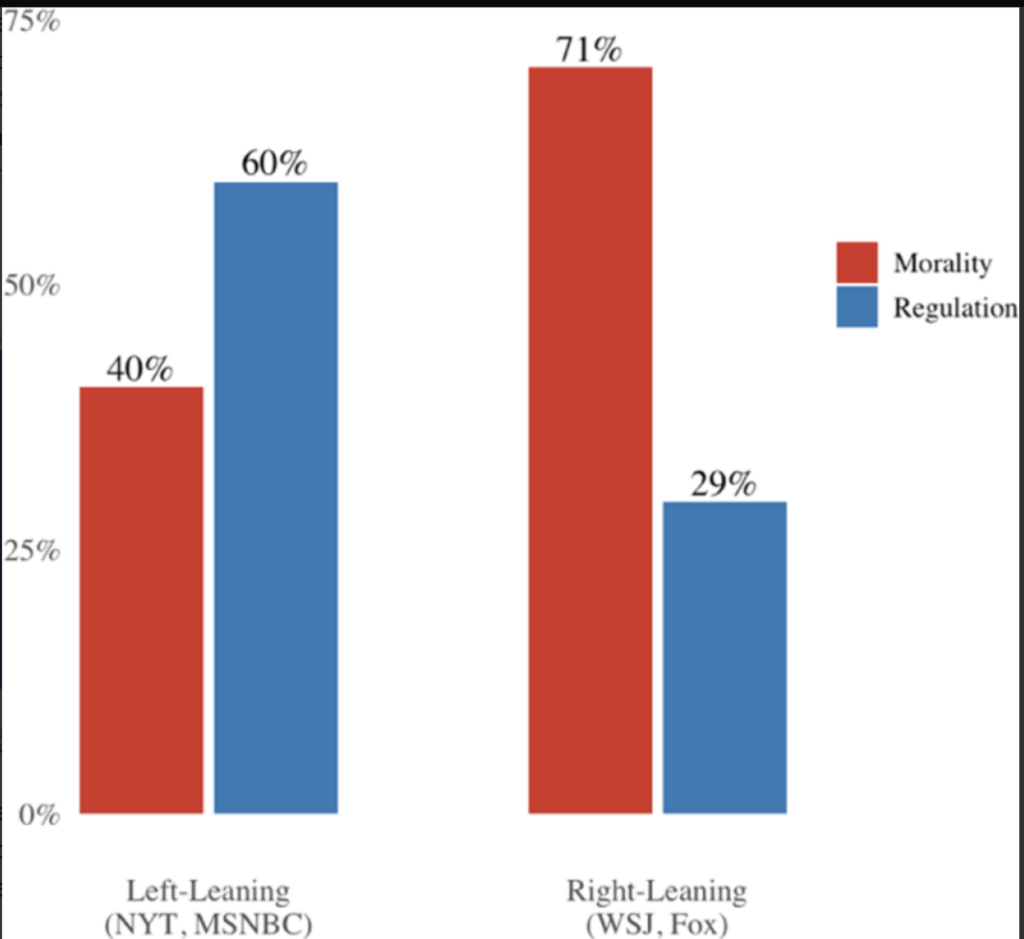
Interestingly, in the experimental condition, it was the right-leaning participants who increased their support for regulation after reading an article on the corporate scandal, but authors believe that this is due to a “ceiling effect,” meaning the left-leaning participants were already at maximum regulatory support. Across the observational research, however, there is a clear trend: “Progressives focused on the lax regulatory environment and the need to prevent future crises while conservatives zeroed on the moral failings of Bankman-Fried.” This regulatory focus from the left could be mirrored in litigation to the extent that jurors see themselves as a form of regulation. In other words, one check on a conspiratorial corporation is a high verdict from a jury.
Understanding and adapting to the fact that jurors are bringing pre-existing frames to apply to your trial story can involve several different steps, and purely by coincidence, I’ve found that all of these steps can start with the letter F.
Follow the Frames (in the Public Discussion)
The first step is to understand what possible frames might be floating out in the public discourse that could affect how jurors understand your case. This step calls for some media awareness and the kinds of research involved in following the issues that are trending, both in the traditional news cycle as well as on social media. If you had a case involving financial market regulation, such as the one tested in the research, for example, then one available frame in the social conversation would relate to the rise of Artificial Intelligence and the fear that humans could be losing control of the systems that govern how we collect and use information. That frame helps to make jurors more skeptical about the effectiveness of current regulations.
Find the Frames (in Your Jury Pool)
The next step is to find out which potential jurors might be adhering to which possible frames. This is the step that involves juror analysis and research. Courts seem to have become more open to the use of questionnaires that can aid in helping you learn what jurors think about issues that could broadly relate to your case. In addition, social media and public records searches are a good way to learn about your potential jurors’ “media diet” and specific interests. While privacy settings will close off access to some information, our own research has found that for around 7 in 10 jurors, there will be something useful in their public information. When working on a case that involves law enforcement, government regulators, or large companies, for example, you’ll quite often find public statements in support or opposition from potential jurors.
Focus the Frames (in Your Case)
Your legal case will always involve a specific story, so another analytical task is to investigate and adapt to the ways your jurors’ general frames will apply to the circumstances of your individual case. You might do that by walking through your trial story and asking yourself what broad public perceptions and reference points might come into play. For example, if you are working on a case that pits an individual against a corporation, what frames of personal or collective responsibility might come into play? Is the story one that suggests a greater need for the individual to have protected themselves, or a greater need for the larger entity to have been more protective? Looking into that question via a focus group or a mock trial can help you decide how jurors’ default frames will come into focus when they interact with the facts of the case.
Feed the Frames (When They Help You)
If you do conduct focus group or mock trial research, one thing you will learn is which frames help you and which frames hurt you. When a frame helps you, you want to feed it – and by that, I mean you want that frame to be more salient, immediate, and available for jurors to draw upon and apply to your case. When you want to appeal to and leverage jurors’ preexisting attitudes and worldviews, there are a few ways to do that. Starting in oral voir dire, you can ask about those potential frames, inviting candidates to “wear” those attitudes a bit. For example, if you wanted to emphasize personal responsibility in an employment defense, then — being careful to ask in a way that puts responding jurors in an “unstrikable majority” to avoid helping the other side — you could ask potential jurors to talk about their own employment experience and the ways they have relied on themselves (and not their employers) for protection. Following up, you can use some of these themes to continue to invoke that framework in your opening statement, your case, and closing argument.
Fracture the Frame (When They Hurt You)
On the other hand, in your pretrial analysis and research, you might discover some frames that are bad for you, and when a frame hurts you, you want to fracture it a bit. I use the word “fracture” rather than something like “overturn” or “refute,” because the reality is that, in a short bit of communication, you are not going to succeed in getting a juror to set aside their outlook, but you may be able to add some cracks. Obviously, the more firmly committed a given juror is to a negative frame, the more they are a great candidate for a peremptory strike. For the rest, however, you might weaken the relevance of a general frame by emphasizing the uniqueness of your story or your situation. Frames work because they’re general. But if your trial story has enough odd features and twists, then it really doesn’t have an easy parallel that jurors can apply. If the corporation that you represent can be convincingly described as being unlike most other large corporations, than it is harder for jurors to apply their one-size-fits-all stereotypes.
In legal cases involving large corporations, jurors can often come in with beliefs, assumptions, or outlooks that will bear on how they see that corporation, and that baggage can be especially salient in the context of an alleged corporate conspiracy or scandal. The study provides clear evidence of one evaluative situation where jurors’ partisan framing makes a great deal of difference. It is the task of informed advocates to understand and adapt to the frames that will make a difference in your case.
____________________
Other Posts on Corporate Attitudes:
- Defendants, Look Out for Anti-Corporate Conspiracists on Your Jury
- Expect More Extreme Anti-Corporate Attitudes
- Bad Company: Investigate the Sources of Anti-Corporate Attitudes
-
Assessing Your Jurors’ Politics? Look for Conspiracy Thinking As Well
____________________
Culpepper, P. D., Lee, T., & Shandler, R. (2026). Media effects revisited: corporate scandals, partisan narratives, and attitudes toward cryptocurrency regulation. Political Science Research and Methods, 1-18.